MDGA Registration
Mini Nubian Breed Standard
The Mini-Nubian is a mid-sized goat being of mixed Nigerian Dwarf and Nubian origin. It is known for being a graceful, elegant animal standing between 23-31 inches and comes in any color or pattern of short, fine, glossy hair. This mid-sized goat is known for its ease of milking; producing a high quantity and quality of milk whose butterfat yield is similar to that of the standard Nubian.
Emphasis is placed on a structurally correct animal with a well-attached mammary that milks with ease. This breed was originally designed for small farms and homesteaders who milk by hand and needed a smaller animal for handling and feeding purposes.
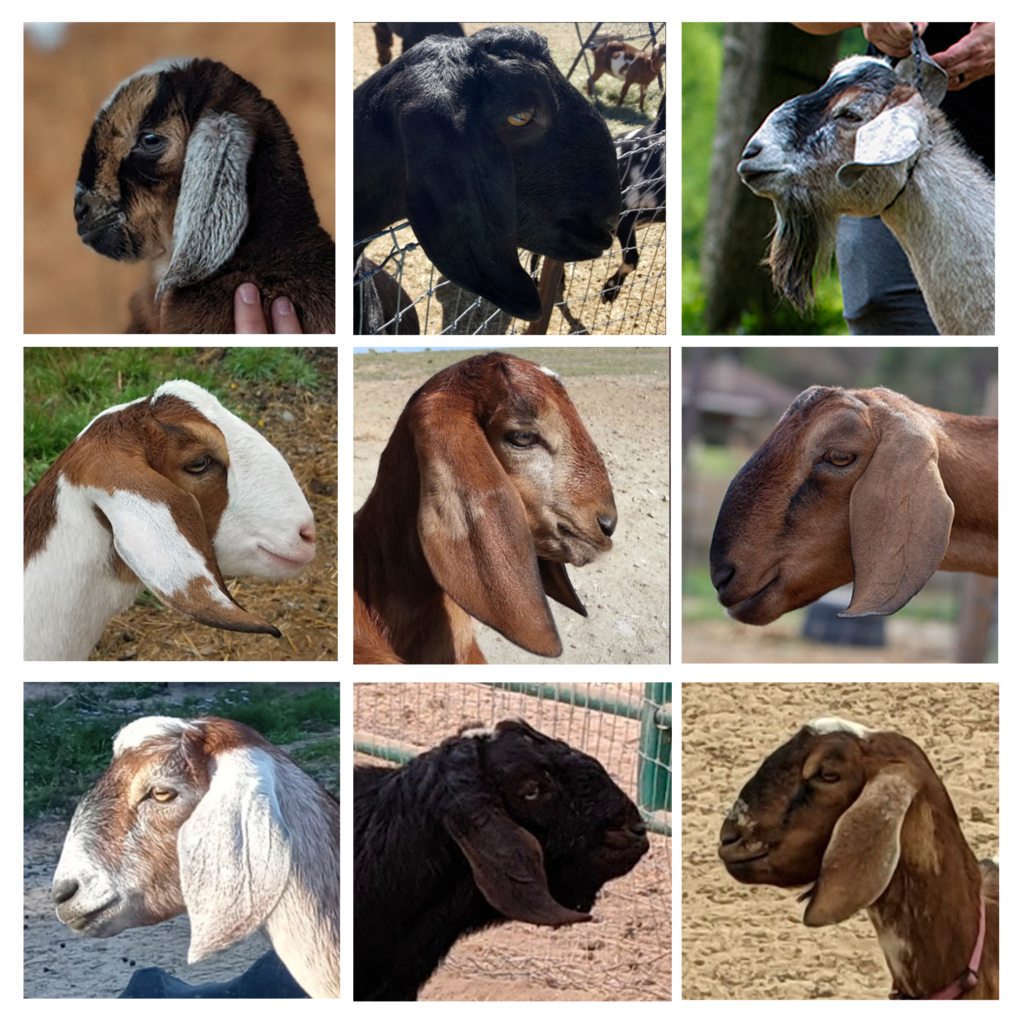
The breed character that sets the Mini-Nubian apart from other Mini breeds, is a nose that is never dished, but slightly to strongly convex (with the strongly convex being more desirable), as well as distinctive, long, wide, pendulous ears that lie close to the head at the area of attachment and stay close to the face while they flare slightly out and well forward at the rounded tip, forming a “bell” shape. The ears are not thick, with the cartilage well defined.
No part of the Mini-Nubian should be coarse, but instead dairy and refined (with masculinity for bucks); with soft supple skin and mammary, strong correct legs, wide flat bone throughout, sharp shoulder blending into a long and graceful neck, and ample width and depth for kidding and milking purposes.
PLEASE NOTE:
***Both Generation AND Breed Standard MUST be met to enter each herdbook***
| REQUIREMENTS | EXPERIMENTAL | AMERICAN | PUREBRED |
| Generation | F1 + | F3 + | F6 + |
| Percentage | Any | Less than 70% or more than 30% of either parent breed. | Less than 70% or more than 30% of either parent breed. |
| Breed Character | Any | Drop or Pendulous ear Ear reaches the start of nostril Straight or Convex nose | Pendulous ears Ear meets end of mouth Convex nose |
| Height | Any | Max: Does 29” / Bucks 31” | Max: Does 29” / Bucks 31” |
**NOTE: For Purebred Herdbook:
* Ears must be pendulous and must reach the end of the mouth at minimum as an adult, with the ideal ear being longer.
* When registering kids, ears should lay past the nose or they will not be at the minimum length by maturity.
* Bucks may reach to the beginning of the nostril at minimum with the ideal ear being longer than the mouth.
DISQUALIFICATION FROM AMERICAN OR PUREBRED HERDBOOKS
Animals will be disqualified from American or Purebred herdbook and placed into the Experimental or American herdbook despite generation if they have any of the following:
Disqualified from AMERICAN herdbook if:
- Animal is over 70% or under 30% of either parent breed.
- Animal has ears that fit the airplane category
- Animal that has ears that do not come to at least the start of the nostril.
- Animal that has a dished nose.
- Animal is over height.
Disqualified from PUREBRED herdbook if:
- Animal is over 70% or under 30% of either parent breed
- Animal has ears that fit into airplane or drop category.
- Animal with ears that do not meet together at the end of the mouth
- Animal that has a dished or straight nose
- Animal is over height
**NOTE ON HEIGHTS: Currently MDGA does not require heights to be recorded with the registry except in the instance of milk testing and live shows. Final animal height is not achieved until maturity (3-4 years old). It is the breeder’s responsibility to ensure their animals are within proper heights, and to submit them to the registry to have herdbooks changed if it is known they are over height.
PROGENY OF DEMOTED HERDBOOK ANIMALS
If an animal is demoted to Experimental or American due to not meeting the breed standard, they will receive an asterisk, * at the end of their registration number. If the demoted animal’s offspring meets generation AND breed standard, the offspring will then be placed in the proper herdbook. If the offspring does not meet the standard and/or generation, then they will be put into the herdbook that they meet requirements.
If any animal applying for the Purebred herdbook has drop ears and/or ears do not meet to the end of the mouth, they will be moved to the American herdbook provided they meet the additional requirements.
EAR DESIGNATION EXAMPLES AND DESCRIPTIONS
NOTE: There are now only three designations: airplane, drop, and pendulous.
- Pendulous: Long ears that lie close to the head at the area of attachment and stay close to the face while they flare slightly out and well forward at the rounded tip, forming a “bell” shape. The ears are not thick, with the cartilage well defined. Ears that angle away from the face instead of hanging down, will be considered as ‘drop’ ears.
- Airplane: Ears parallel with the top of the head sticking straight out at the base of the ear.
- Drop: Ears veer away from the face at more of an angle versus parallel. The base of the ear is not as tightly held to the head.
To assist in determining the type of ear, registration will utilize an objective tool to measure the angle of the ears. Please feel free to try using at home with your own goats using these directions:
Here is a free online application to use, but any application may work, go to www.fotor.com then click start photo editing, download the image you want to use, then hit the layer button over the photo (top left of photo), then you upload the tool. Once you have the tool over the photo, above the photo is a transparency option you want to change it from 100% down to 22%. This will allow you to view the picture with the overlay.
Here is the tool which describes the angles in which more than 50% of the ear must occupy to determine “type”:


AIRPLANE – Ears that proceed straight out from the head (as in airplane wings). They may have the slightest drop downward or the slightest rise upward a bit.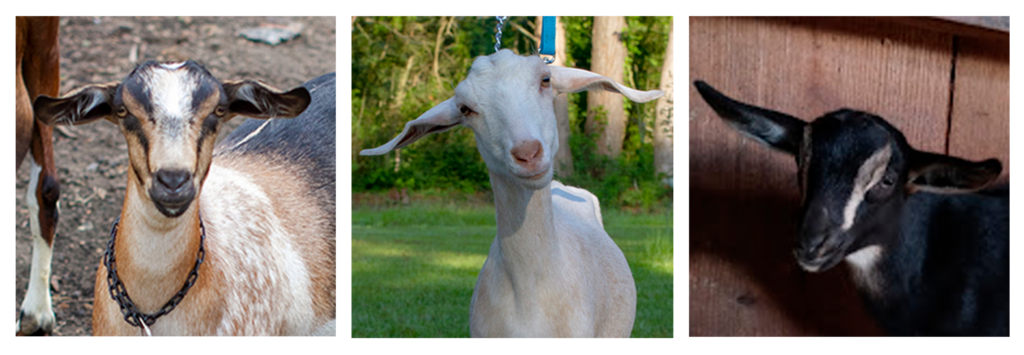
DROP – Drop ears – all ears that are between airplane and pendulous. They may come out from the face and then drop, or may angle out from the head more than allowed in pendulous. Drop ears are often more stiff than desired. This designation will also include ears that are too short even though they may be close to the head or appear pendulous. Too short is anything less than meeting at the beginning of the nostril (for American) or meeting at the end of the mouth(for Purebred).

PENDULOUS – Long ears that lie close to the head at the area of attachment and stay close to the face while they flair slightly out and well forward at the rounded tip, forming a “bell” shape. The ears are not thick, with the cartilage well defined. Ideal pendulous ears are wider at the base with a “bell” shape curve. Ears that angle away from the face instead of hanging down, are considered as ‘drop’ ears.
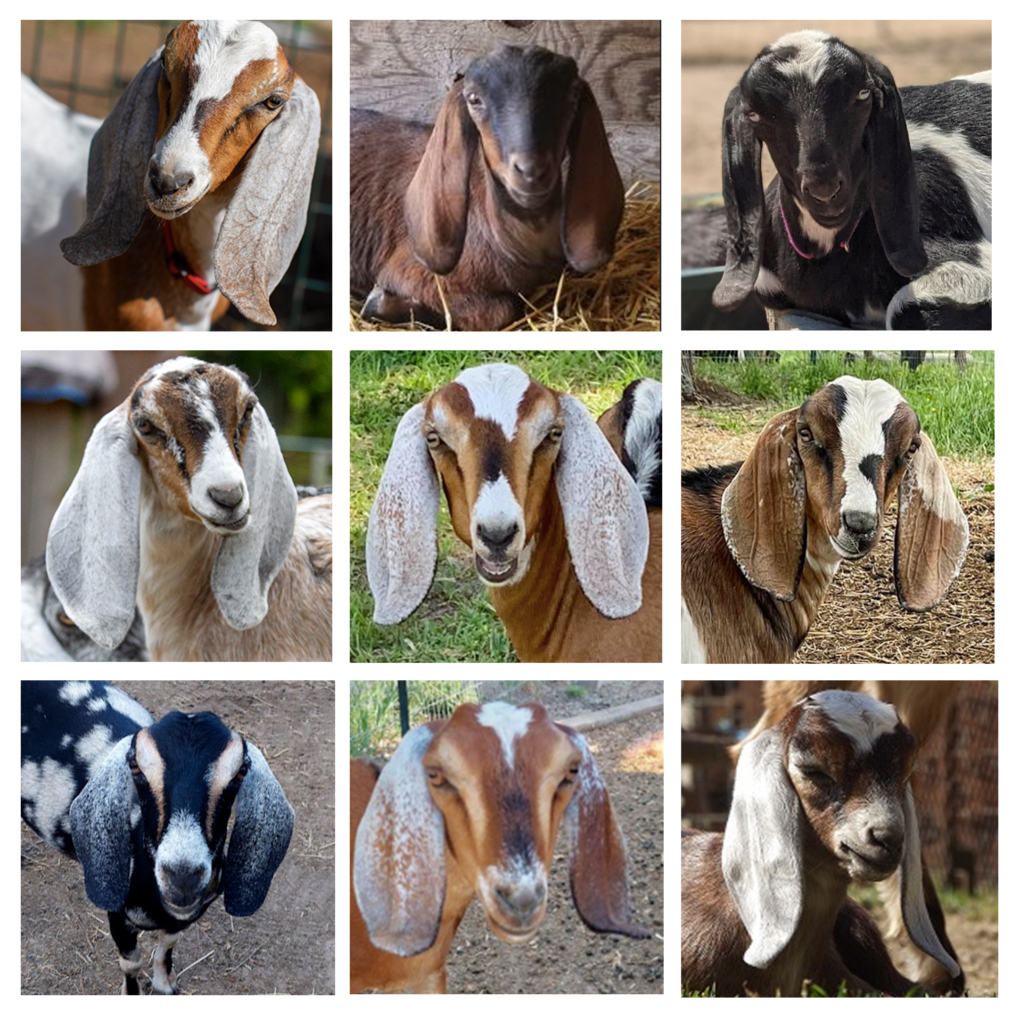
EAR LENGTH: When entering the Purebred herdbook, as kids, ears should reach the end of the nose and touch at the tips when held along side the face. In order for ears to reach the end of the mouth by maturity, they must reach past the nose and touch, as a kid. For an adult entering the PB herdbook, ears must reach the end of the mouth at minimum, past the mouth is ideal. For adult BUCKS entering the PB herbook, their ears must come to the beginning of the nostril at minimum.
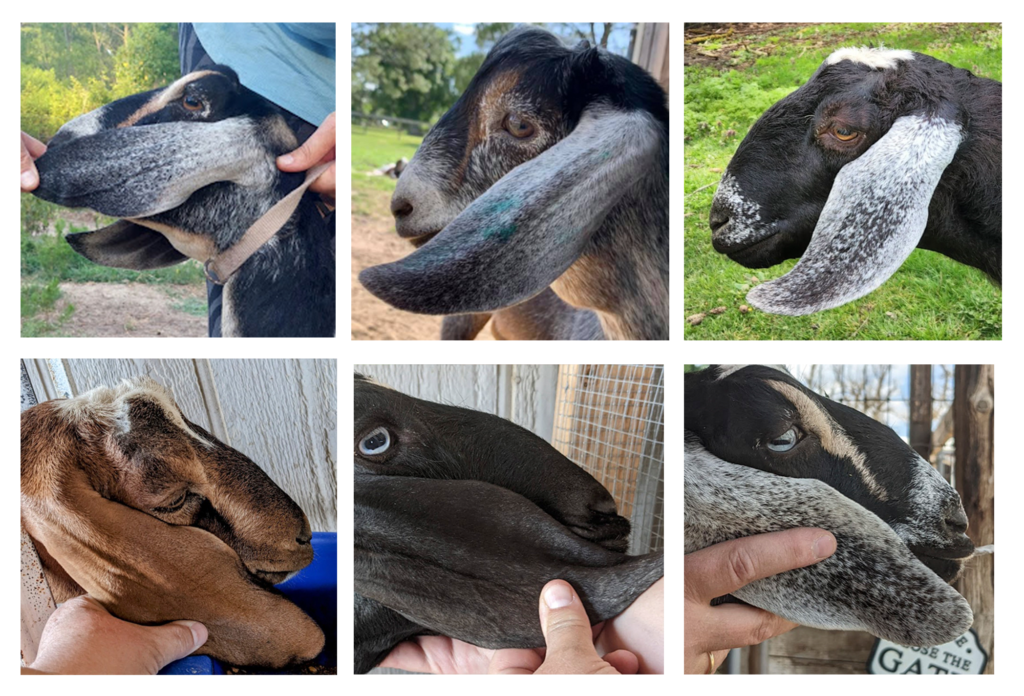
The following ear lengths are accepted into the American book as they reach at minimum, the beginning of the nostril but will not necessarily reach the end of the mouth and touch. They must also be at least drop or pendulous to be in the American book.
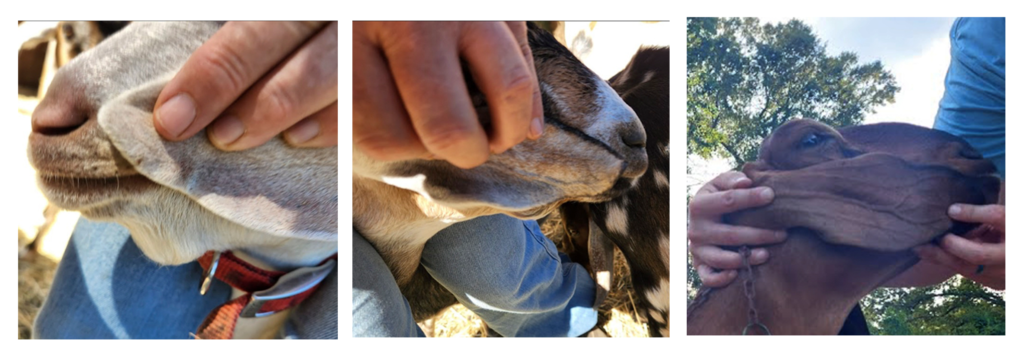
STRAIGHT and DISHED NOSES: Dished noses are acceptable in the Experimental herdbook only. Straight or Convex noses are accepted in the American herdbook. Any animals entering the American herdbook that have dished noses, will be placed in the Experimental herdbook. Any animals entering the Purebred books that have dished noses will be dropped to Experimental despite generation. If an adult animal is entering the Purebred herdbook and has a straight nose, they will be placed into the American herdbook provided they have the proper ears, otherwise they will be placed into the Experimental book.
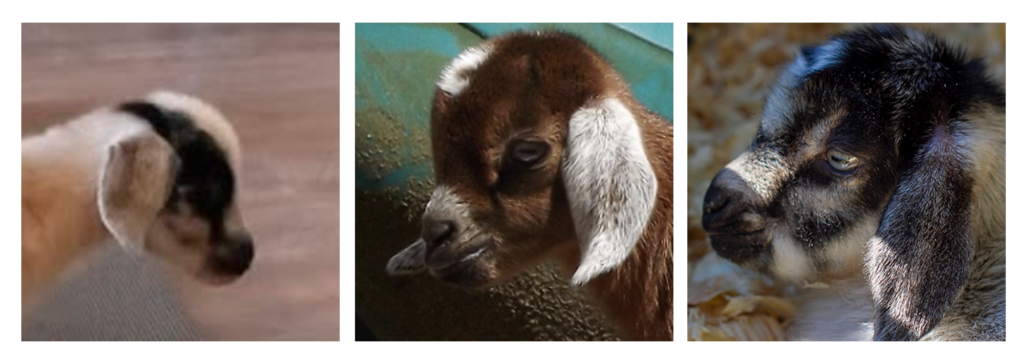
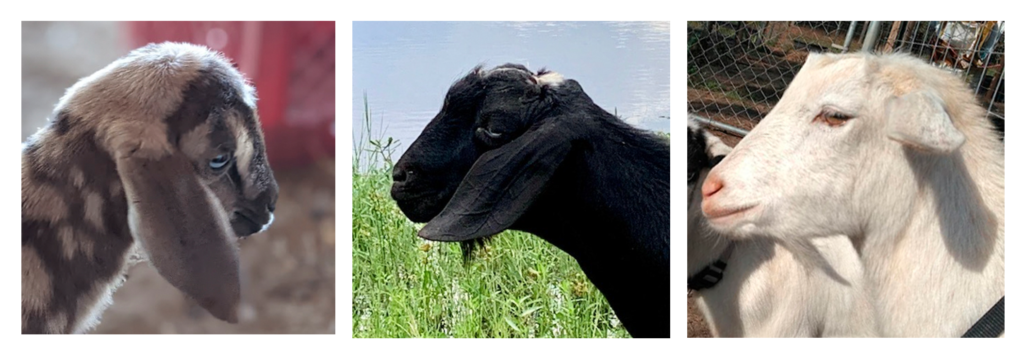
CONVEX NOSE: The ideal nose will have a strong curvature or arched look to it (ideal). However, concerning the Purebred herdbook, as long as there is ANY, even slight, curvature, the animal will be accepted. Mini Nubians noses do not fully mature until well into adulthood. The registrars are fully aware of this and take this into consideration when evaluating kid and adult pictures submitted for the Purebred herdbook.
Become Part of Our Community
Elevate Your Breeding Expertise with MDGA: Connect with a vibrant community of breeders, access specialized resources, and participate in exclusive events. Join MDGA and transform your passion into success.